CREATIVES: Filmmakers Glenda Drew & Jesse Drew on ‘Open Country’ documentary
This interview originally aired on Wednesday July 9th 2025 at 5pm.
WRFI talks to filmmakers Glenda Drew and Jesse Drew on their documentary 'Open Country'.
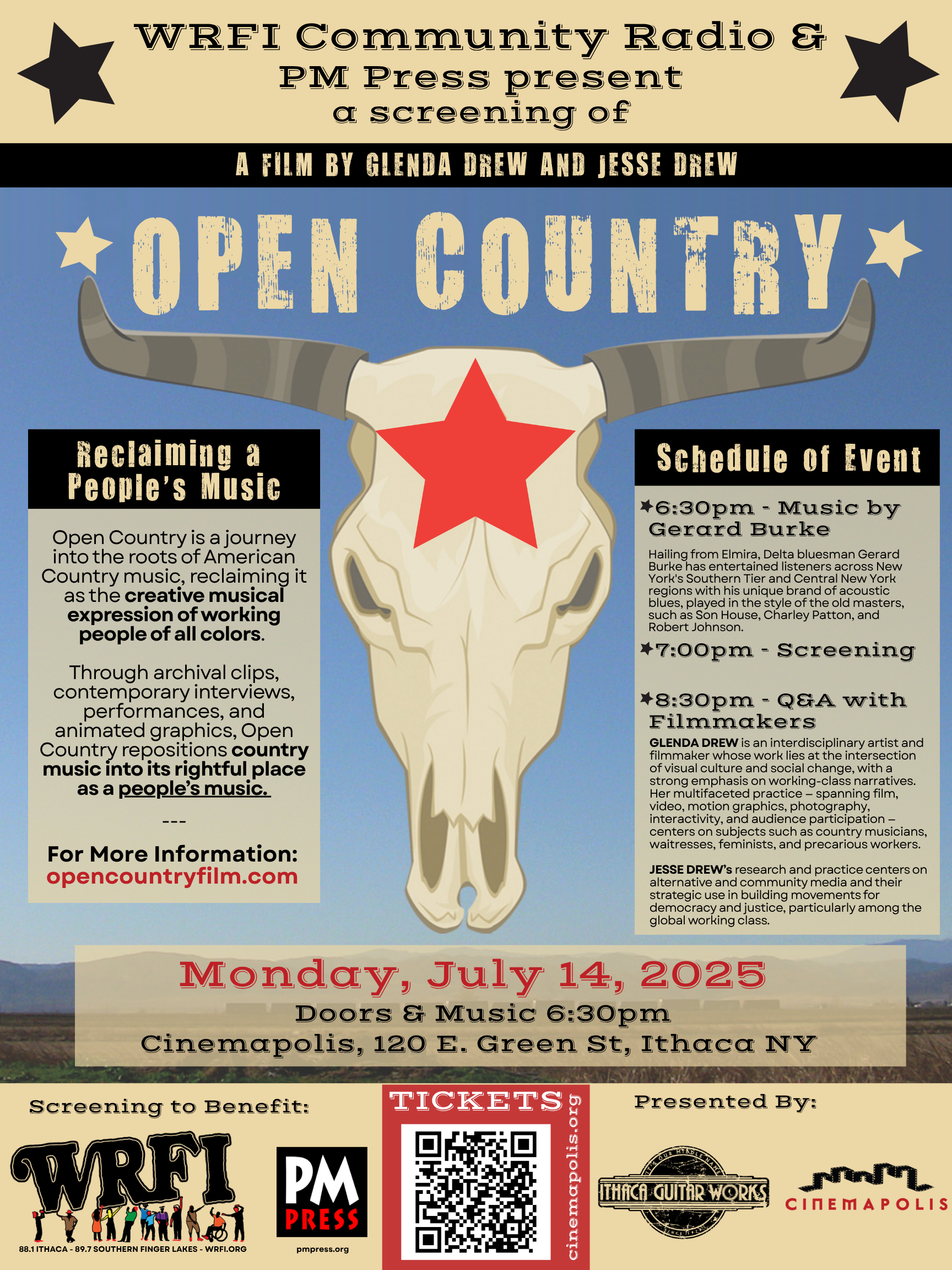
Join WRFI for a screening of 'Open Country' on Monday July 14th at 6:30pm, with a Q&A with Glenda & Jesse following the screening.
ABOUT THE INTERVIEWEES
Glenda Drew is an interdisciplinary artist and filmmaker whose work lies at the intersection of visual culture and social change, with a strong emphasis on working-class narratives. Her multifaceted practice — spanning film, video, motion graphics, photography, interactivity, and audience participation — centers on subjects such as country musicians, waitresses, feminists, and precarious workers. Influenced by her formative years with Paper Tiger Television in San Francisco, drew embraces a DIY aesthetic and media-critical approach aimed at accessibility and social critique. She is an active member of the Class Conscious Photographers and Artnauts collectives. Through her work, drew continues to explore the power of media to question, connect, and catalyze change. She is currently professor of Design at UC Davis, where she teaches screen-based interactive design.
Jesse Drew's research and practice centers on alternative and community media and their strategic use in building movements for democracy and justice, particularly among the global working class. An active audio-visual artist, his interactive, cinema, photography and installation work has been featured in showcases and galleries internationally. His writings have appeared in numerous publications, journals and anthologies, including Resisting the Virtual Life (City Lights Press), At a Distance (MIT Press), Collectivism After Modernism (University of Minnesota), and West of Eden (PM Press). His book, A Social History of Contemporary Democratic Media is published by Routledge. He is currently professor of Cinema and Digital Media at UC Davis, where he teaches media archaeology, radio production, documentary studies, electronics for artists, and community media. Before coming to UC Davis he headed the Center for Digital Media and was Associate Dean at the San Francisco Art Institute.
ABOUT THE FILM
"With the twang of a steel guitar, the whine of a fiddle and the plunk of a banjo comes an instant association; the pick-up truck, the cowboy boots, the rolling hills, dusty fields, lonesome highways and the flag. Lots of flags. The twang of Country-Western puts you into the American heartland, on the ranch, the farm, or in the honky-tonk or beer hall. For many, it has also come to signify conservatism, “traditional values,” American chauvinism, or even racism, bigotry and the confederate flag. Country-Western music has been prominently featured by every major contemporary Republican figure, from Richard Nixon to G. W. Bush. George Bush the elder claimed Hee-Haw as his favorite TV show. Consequently, no one is too surprised when Country -Western radio disc jockeys smash CDs or ban music from groups taking positions frowned upon by the right-wing.
Does Country-Western deserve this reputation? Like the flags they fly so fervently, the right wing likes to promote this claim to ownership. But history and facts do not bear them out."
Learn more about the film at opencountryfilm.com